I’ve noticed how traffic has picked up on this little spot since I began over a year ago and, in the great Lester Bangs tradition of re-evaluation and reflection, I wanted to take a station identification break to put a few salient points across………..just in case people are actually reading this blog......hey, you never know!
First of all, I’m just some guy with a stereo and a music collection who likes to write in his spare time instead of watching TV. Not everything I write makes sense and neither are my declarations definitive. I can notice mistakes and misinterpretations in my pieces – sometimes merely days after publishing them. But I’m inclined to leave those entries alone with the door open to disagree with myself later on down the road.
The raw material for my rants is derived from multiple sources – books, articles, record sleeves, internet discussion sites, etc… Some of these sources contain accurate information; some are dubious in nature. I do my best to cobble together a cohesive position on topics that mean something to me using whatever sources appear most legitimate. If I end up perpetuating a myth in the process, most of the time it’s unintentional or, at least, inconsequential.
Mostly the goal here is to spread the word a little about music that I like. Since I lean toward the position that artists should be compensated for their work I won’t post links to free downloads here. For illustrative purposes I might post a u-toob link, but that’s as far as I’ll go. Music is worth a financial investment because it can improve the quality of life for someone who places value on good music. And having a great-sounding copy of a piece of music you like can be an ear-opening experience.
To give you all an idea of what I might be hearing from a particular record, CD or tape I’d like to reveal a little about my listening hardware. This is not to brag about what great gear I have – on the contrary, my main listening hardware is quite modest. But I feel that some of my assertions and conclusions are the result of certain equipment choices that I ought to make obvious. My main listening rig looks something like this:
Turntable: Project X-Pression - this is the fanciest piece of equipment I have. Even still, I bought a used floor model several years ago that I had to replace the motor on (inexpensive and easy thank God!) so it isn’t that fancy, but it sure sounds great with…….
Cartridge: Audio Technica 440 Mla (a bit pricey nowadays, but still great bang for the buck)
Receiver: Lafayette LR-5000. Although this is far from audiophile, it is known for being a great little 4-channel amp with a decent SQ matrix decoder built into it (for my quadraphonic record addiction). Since my listening area is pretty small it puts out plenty of signal for me in either 4 or 2 speaker mode. Most of my listening is done with the front left and front right speakers (with the rears silent unless I’m in surround mode) – my main speakers since 2009 have been………
Speakers: KLH 38s. 2-way, acoustic-suspension, Henry Kloss-designed, 10” woofers, pretty neutral sound, really balanced speakers. The bass isn’t earthshaking, but there’s enough oophm for me. These speakers look like hell and sound great.
CD Player: NAD 5340 – early 90s vintage player I got from a Goodwill for $12. Most of the time it works fine and sounds good. Needs a little work, but I’m happy for now.
I have a few other pieces of equipment, but the above units are the first string players on the team. So, I’m only enough of an audiophile as my bank account will allow, but I think my stuff isn’t that bad and gives me a decent ear-view into the music I enjoy.
What my choices reveal is an obvious leaning toward vinyl records. I do enjoy CDs and digital music as well, but something keeps me from stepping up to that two-thousand dollar CD player (they are out there, folks!). My $12 NAD does the job very nicely thank you. But vinyl can be a very different story. Here’s a recent experience to illustrate……..
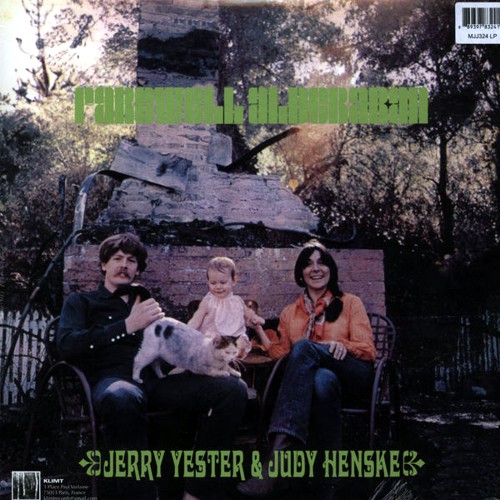
A few entries ago I did a whole deal on “Farewell Aldebaran” by Judy Henske and Jerry Yester. Great album. Yet my whole understanding of the record was based upon tracks I listened to off u-toob. Reading back on what I wrote, although I enjoyed the record, some of my comments sound too critical in retrospect. I decided to dig a little deeper and bagged an original LP copy from THAT AUCTION SITE. People, here is a great example of how an original LP played on halfway decent equipment can TOTALLY ALTER YOUR PERCEPTIONS about music you know and love. Played on the Pro-Ject table with the AT Mla 440, the original pressing of “Farewell Aldebaran” was so vastly superior to what I had been hearing – I was blown away!!! There was an immense depth to the music that was totally absent from the u-toob rips (which were quite clean, actually). If I had assigned the record to the “cult classic” bin in my mind, hearing the original pressing elevated the record to “masterpiece” status in pretty short order. I’m sure my turntable / cartridge setup helped matters, but in this case the source material made the difference.
ORIGINAL COPIES WILL BLOW YOUR MIND!!
Not to say that all first pressings are superior to re-cuts or reissues. It can be a case-by-case basis unfortunately. But, when things come together like they did here – HOLY SMOKES! It’s best to do some research. For instance – original US Capitol Records pressings of Beach Boys and Beatles albums are not superior to later 80s recuts. In the case of Capitol US, the mastering and pressing practices only got better from the 60s to the 80s.
Now, collectors tend to be less enthusiastic about reissues than listeners. Collectors are willing to pay big bucks for original sealed copies of Pet Sounds simply because it is an original pressing. Listeners know that the 1980s green-label Capitol reissue of Pet Sounds is sonically superior to the original – and they are happy to discover pristine copies of this issue for about $10 at the local used record shop.
LOOKS COOL - SOUNDS YUCKY!
LOOKS DOOFY - SOUNDS SPECTACULAR!!
It's all about the mastering and pressing practices of any given company at any point in time. Sometimes they get it right the first time, sometimes the best pressing is the most recent. With so many options available to music lovers these days there's a pretty good chance that somewhere out there is a great sounding copy of music you like. Part of the fun is figuring out what's what. The same can be said for CDs - soon enough I'll spend a little time on the format everyone loves to hate these days - and what a pity! The CD era was quite exiting - and it still is if you know what to look for. Until then - HAPPY LISTENING!!!
Charles Mingus. Even if you own just one of the many great albums Charles Mingus released in his long and varied career it is very likely it contains music thoroughly infused with the potent and heady flavor that can only be described as MINGUS FLAVOR. But it’s not like a flavor of ice cream that has only one taste to it. Or like an actor such as John Wayne who can only play one type of character – himself. This is the way it is with music – how sound can be imprinted with such a strong personality that no matter if it’s a ballad or up-tempo number – the identity of its creator is INSTANTLY RECOGNIZABLE. Can we put it down to the church-y bluesiness? The call and response? The vocalizing? The trombones? Heavy riffing? Or just sheer force of will on unsuspecting air molecules?
I don’t know what to put it down to, but every so often I put on a Mingus album and I am confronted with THE BEST MUSIC I’VE HEARD THAT WEEK. Different albums. Different sidemen (though usually always featuring the wonderful, woefully under-recognized Dannie Richmond on drums). What I love most about Dannie Richmond is his swinging flexibility – the way he telepathically moves along with Mingus through all the complex arrangements – those two were psychically fused – two men, ONE BRAIN! Maybe the only reasonable explanation for how he successfully navigated those diabolically unpredictable tempo and rhythm changes Mingus loved to incorporate into his many compositions. Here’s a great photo of Dannie Richmond:
And that, to me, is what Mingus will be remembered for – great compositions (and recordings of those compositions). His music has stood the test of time and, I am convinced, will continue to do so. For some reason I was thinking of Charles Mingus as amongst the great American Composers – right up there will Aaron Copeland, George Gershwin and Charles Ives. Miles Davis may have put out great albums like Kind of Blue, but Mingus one-ups him in terms of great compositions.
Although Mingus was not happy with the interpretation, the first I heard of Mingus’s music was on the Jeff Beck album “Wired” where the standard “Goodbye Pork Pie Hat” was a featured cover tune. It really is a soulful interpretation, though part of Mingus’s complaint had to do with some missing chord changes on Jeff Beck’s record. I reckon Mingus didn’t mind the royalty payments from the album though. Yet, as truly wonderful as his music is – there aren’t very many folks looking to cover Mingus tunes. Ray Davies went out of his way to rectify this situation with a film and album in the early 90s done as a tribute to Mingus the composer – a joint venture with the great Hal Wilner called “Weird Nightmare” after that most puzzling Mingus song. Here’s the documentary which includes folks like Elvis Costello, Vernon Reid and a few Rolling Stones laying down some tracks in honor of the great man himself. I love how the neighborhood of the recording studio forms the backdrop of the documentary – Astoria in Queens, New York City. This is nearby my roots and its fascinating for me to see some of my musical heroes hanging around a part of the city that looks very much like my childhood stomping grounds (with the elevated trains and whatnot).
There is NO WAY just one blog entry will accurately convey the sheer awesome-ness of Mingus. There are a couple of biographies available which I have read. The more recent one, Myself When I am Real by Gene Santoro is an exploration into Mingus the man and to his credit, Santoro does manage to humanize the man behind the talent. But Santoro’s writing style tends to grate on the nerves after awhile (I have never encountered a single work by any writer that over-uses the term “Zeitgeist” more than Santoro does in this book and it’s FREAKING ANNOYING, dude. Sorry – I just had to put it out there.) Another book I read focuses more on the music than the man: Mingus – A Critical Biography by Brian Priestley. While this books is much less hysterical in its prose than Santoro’s book, the reluctance of the writer to delve a little deeper below the surface of this fascinating subject results in a work that is perhaps too academic. I would love to read a more sophisticated analysis of Charles Mingus and his music someday…….
Soulful, sophisticated, funny, earthy, transcendent, roots-oriented while simultaneously future-oriented. Mingus music has it all. Another early encounter with Charles Mingus for me was this 2-LP set I borrowed from the local library (when they had LPs) – a collection of Mingus albums he did for the Prestige label in the mid-1950s.
The updated cover art is sooooooo deceptive though. Here, Mingus looks like some jolly, jovial Buddha-esque character. Riiiiiiiiight! Of course, he had his share of troubles – both internal and external. But even though his decline was long and protracted, there remains such a legacy of inspiration, seeking and general enthusiasm for life in his work – it cannot be denied.
Already this entry on Charles Mingus has taken up so much space and yet I feel like I haven’t even scratched the surface of all the great memories I have of his music and what it means to me. So I’ll warn you now - Mingus will make a comeback here in the near future. In the meantime, feel free to purchase any one of the following Mingus albums that are guaranteed to BLOW YOUR BLUES RIGHT OUT OF YOUR CONSCIOUSNESS. Howza ‘bout…….
1. Mingus Ah Um…….
2. Tijuana Moods
3. Mingus At Antibes
4. Mingus in Wonderland
Any of the above titles are sure to get your juices flowing. And here’s another great documentary about Mingus called “Triumph of the Underdog”. Really, this is all just a beginning……….
I was putting together a new piece based on the merits of the blank C-90 cassette tape which I’ll post later on down the line here. But in the middle of that I got totally blindsided by a single song by Sandy Denny. Y’know – I listen to a LOT of music. And I’m not always affected by lyrics – more often by the composition as a whole – the whole record – melody, chords, tambre, production – the big picture. But I think I finally discovered the most profound, heart-wrenching, devastating recorded piece of music / performance / composition of (at least) the 20th Century…………
I throw my hat into the ring for…………..One More Chance by Sandy Denny on the Gold Dust CD - recorded (basically) live at the final show of the last tour she ever did before her untimely, sad death at the tender age of 31.
“Is it too late………to change the way.…….we’re bound to go……is it too late……….surely one of us must know…..”
The drama of the song and performance here is already pretty high, but leave it to (the great) drummer Dave Mattacks to ratchet up the stakes higher still with one of the single best performances of any drummer backing up a singer who is transcending the moment on an already staggeringly sophisticated level – pushing the proceedings to further heights of drama that most likely neither one could have ever imagined.
I’m a drummer myself and although there are many drummers whose work and technique I admire, I have to admit there is only one drum sound I have ever LUSTED after and that is the drum sound / approach / fluidity / sympathy exhibited by Dave Mattacks on this recording and on several other recordings of this era of the mid-to-late 1970s. There is some kind of major drum set / tuning / miking / mixing / atmospheric pressure / whatever he was eating that year / other arcane variable MOJO going on with Dave Mattacks in this time period that is just ……… staggering to my ears.
The song itself has a built-in drama. There are two competing elements that alternate throughout the song and to greatest effect during the guitar solo sections: a brooding minor-chord progression reminiscent of dark clouds threatening from above contrasted with a bright and sunny major-chord progression that sounds like the sun trying to break through the storm clouds chasing the gloom away…..even if only temporarily.
“Is it too late………to change the way.…….we’re bound to go……is it too late……….surely one of us must know…..”
The fatalistic refrain follows the guitar solos. Sandy Denny’s fate was cruelly tragic. At the time of the recording she was just returning to live performance after a two-year hiatus during which she had recently given birth to her only child. Her marriage was shaky, but there was a hopeful eye to a renewed career. The recording issued proved to be her last, however. Only 31 years old, Sandy Denny suffered a fatal fall down a flight of stairs, fell into a coma and passed away.
Years ago I read a biography about her. Such promise and talent cut down too soon. Most rock music fans might only recognize her name connected with Led Zeppelin IV. She performed the duet with Robert Plant on the song just before “Stairway to Heaven” – the often overlooked “Battle of Evermore”. Though it is arguably Sandy Denny’s most high-profile performance, it is not exactly her best or most-representative of her talents. How she came to the attention of the Zep guys had to do with her membership in that chameleon-like British folk-rock institution Fairport Convention.
The Fairports had put out a record in 1969 with Sandy Denny in the lineup that has since become a legendary piece of modern music – the album “Liege and Leif”. The concept was to re-work traditional British ballads with modern rock music arrangements. Surprise! It worked. What The Band’s “Music From Big Pink” did for the resurgence of American roots music, “Liege and Leif” did for a revival of interest in Celtic and traditional English folk music. The impact was not lost on the rock community at the time. New to the group on that record was the wonderful drummer Dave Mattacks, who would continue on through a few different permutations of the Fairport Convention as well as working with both guitarist Richard Thompson and Sandy Denny on solo projects when both of them would depart from the Fairport nest.
But even before Sandy was part of Fairport she had written a song which turned into a hit for Judy Collins called “Who Knows Where the Time Goes”. In fact, I always thought of Sandy Denny’s voice as being like Judy Collins’ but WARM and inviting as opposed to cold and detached. The effect, for me, of hearing Sandy Denny sing is straight-up SWOON CITY. Some performances of hers just get me all misty-eyed and defenseless. What the sound of the violin did to Frankenstein – Sandy Denny’s voice does to me. With her finer moments I am reduced to a glassy-eyed, pathetic creature – and unashamedly so!
Anyway – this song just absolutely flattens me. Heart-wrenching drama – beautifully sung, passionately performed, excitingly drummed to – this track has it all, folks. About ten years ago I went to the Rock and Roll Hall of Fame alone for my birthday. I was newly broken-up from a relationship gone bad and I wanted to do something rewarding on my own. It was a good trip and I spent a lot of fun time checking out various exhibits as well as a record show being hosted there that weekend. But one of the really transcendent moments I had involved a little area with a TV and a video clip of Janis Joplin’s performance of “Ball and Chain” at the Monterey Pop Festival in 1967. You could push a button and the clip would play on demand. I stood in front of that stupid thing in the middle of a sea of strangers watching that video a good three or four times and I can tell you there may have been a tear shed in that moment.
I learned then that any singer, musician, performer has the possibility of experiencing a TRANSCENDENT MOMENT where time stops for their art, their moment. For me, Janis Joplin never was better than on that Monterey stage – a truly spellbinding moment. Some singers can do that more than once. Sandy Denny hits that mark for me in many of the recordings I have of her. But none are more stunning than “One More Chance” recorded at her final performance.
Don’t get me wrong – there are some GREAT talents amongst female musicians and singers. But, if push came to shove – I’d put Sandy Denny at the top of my heap.
If we allow ourselves to follow the development of what became known as “folk-rock” from Bob Dylan to the Byrds to the Jefferson Airplane, this progression creates a neat historical outline we can hang our hats on. Yet this is all hindsight. Maybe these three acts represent the three major changes in the genre - Dylan making the sea-change from “pure folkie” to “electric” ; The Byrds adapting to current pop trends (Beatles) ; The Jefferson Airplane then carrying the folk-pop football into full-blown psychedelic madness. A reasonable passing of the musical torch from one innovation to the next – from traditional to commercial to esoteric.
Yet there were many interesting off-shoots and pathways along the development of this genre-shift in the1960s. As far as I’m concerned, the only major act to give The Byrds any serious competition in the folk-rock world, in terms of sheer quality of material, was The Lovin’ Spoonful. Though, technically, they called their music “electric jug band music” and did not try to compete with the morose subject matter then prevailing in the lyrics of the folk-rock genre (epitomized by “Eve of Destruction” – what a bummer that record was, eh?). Besides - they all dressed differently with loud striped shirts and wrote upbeat, catchy tunes. And they sure had chemistry onstage – check out this great clip from the TNT Show:
Alongside their hit singles and great LPs (best heard in mono), the Spoonful worked on films. In fact, one of my favorite songs of theirs is the theme to a Woody Allen film (What’s Up Tiger Lily?) called “Pow”. A real wacky classic – listen here:
They were riding high – well, maybe a little too high. Of all things, guitarist Zalman Yanovsky got busted for the green leafy stuff and, since he was Canadian and facing deportation, cooperated with the authorities a little too much for the burgeoning counter-culture scene to handle. The credibility of the group took a blow and Zally was forced to depart from the band. Scandal! The Spoonful continued on with a replacement – Jerry Yester. But it wasn’t the same. The chemistry was gone and after a few more albums The Spoonful packed it in. Interestingly, Yanovsky remained active in the music business for a few more years before moving back to Canada to become a successful restaurant owner up to his untimely passing at the too-young age of 57. Yet, he did put out one gloriously wacky solo album and a pretty good single – listen here:
But he was more active on the production end of things before bailing out of the music biz for good. Of all people to partner with as a record producer, his replacement in the Spoonful, Jerry Yester, was the guy. No hard feelings apparently! It just so happened that Yester was married to a woman who also had roots to the folk scene of the early 1960s (though she never fit comfortably in that scene either and she missed the boat to folk-rock land when it sailed………):
Judy Henske
“Chanteuse for the Apocalypse” is just one of the many interesting monikers used to describe the astonishing vocal abilities of Judy Henske. I’d read her name for years before I heard her voice. And the first place I did hear her was a pretty unusual record – a collaboration with her then-husband Jerry Yester titled “Farewell Aldebaran” which was co-produced by……Zal Yanovsky! Now, I don’t have a physical copy of this – yet. I only ever heard the tracks from u-toob, but this is one record Frank Zappa should have released on the Bizarre imprint instead of the Straight one. Actually - the record had zero input from Frank, Henske and Zappa shared the same manager – Herb Cohen (who was Zappa’s business partner for Bizarre/Straight). In recent interviews Henske has spoken highly of Zal Yanovsky – echoing many fans opinions of him that, although John Sebastian is a great songwriter and singer, Yanovsky was THE GUY in the Spoonful – the mystery ingredient. Henske ought to know a thing or two about mystery since she’s got heaps of it hiding behind every nook and crannie of her vocal talent. And her impact on popular music cannot be denied. Ever hear the first Jefferson Airplane album – the one before Grace Slick joined? The Airplane’s original singer – Signe Anderson – was, for all intents and purposes, a Judy Henske wannabe clone. Take a listen to Henske’s version of “High Flyin’ Bird” (released three years before the Airplane’s) here:
The Airplane took this arrangement directly from Henske lock, stock and beatnik. I’ve read at least one writer who called Henske the “female Fred Neil” who was also an influence on the Jefferson Airplane (though my ears tell me I can’t really get with that comparison exactly).
“Farewell Aldebaran”, as it turns out, was actually nearing the end of the first chapter of Judy Henske’s career. Her previous records were more in the folk vein, so this release was quite a departure. It walks a fine line between dual ambitions of being a finely-crafted psych-folk classic while at the same time seeking to update and enhance Henske’s appeal in the marketplace (such as it was then). Yet putting an ambitious psych-folk album out on Frank Zappa’s record label may have been too far out. I am certain this is where most rock fans heard her voice for the first time just as I did and were probably as confused as I was. Trying to unravel Judy Henske’s mysterious identity is not easy when you start off with this record. Is she a rock singer? Folk singer? Jazz singer? Pop singer? Well, she covers all that territory here, only in the context of a pretty ambitious production. In fact, Yester’s production isn’t psychedelic in the stereotypical sense. This album must be one of the earliest (successful) uses of proto-synthesizers. The resulting record is at once folk, rock, psych and PROG. Oh, and there’s this mysterious woman singing on it………….now that I think of it – I’d be mighty surprised if Kate Bush had never heard this record in her formative years. Not that the vocal style sounds like Kate Bush, but the way Henske uses the different shadings of her voice to create moods and characters is utterly groundbreaking in the way that Kate Bush would be in the late 70s and early 80s.
“Farewell Aldebaran” came to my attention through the Zappa connection. It was recently given a little profile on a DVD dedicated to celebrating the Bizarre / Straight label (which included such diverse acts as Captain Beefheart, Tim Buckley, Alice Cooper and The Persuasions). It’s a great DVD. And writer Richie Unterberger, through his passionate advocacy of this record, convinced me to give it another listen. Why did I need some extra prodding? Simply put, “Farewell Aldebaran” ranks as one of the most disorienting albums I have ever heard. I literally couldn’t make it past the first four songs without feeling sonically overwhelmed. There’s so much going on in the first 12 minutes of this record it can take time to digest. The overall production is psychedelic, but Henske’s vocal delivery is psychedelic enough without the extra effects!
Here’s a breakdown of the opening four songs with links to hear them….
Snowblind – starts out normally enough, but quickly takes a sharp turn to…….godalmighty! Heavy Metal? The backing music is near-atonal wreckage unconvincingly masquerading as rock and roll. The slapback effect on the vocal chorus just adds to the anarchic cacophony. Henske’s vocal delivery here is so over the top in a way that makes Janis Joplin sound like Nico! I guess this is what one critic described as a “voice that can shatter windshields”.
Horses on a Stick – right away I can’t help but notice the keyboard sound that Zappa used on “Little House I Used to Live In” – the one that sounds like a ringing doorbell. So this is a song about a Merry-Go-Round. Very cheerful pop production with Henske’s voice in a much more sweet and innocent tone. Fits the music perfectly, but …… is this the same singer we heard on the first track? Huh…..alright….two totally different styles right off the bat on the first two tracks of the album. Not unheard of for this era….but still hard to reconcile as coming from one person….hmmm…..
Lullaby – harpsichord…..slow…..tinkling intro with piano. Henske’s voice is a haunted, quivering, spooky – no, …………CREEPY and breathy creature here. Nightmarish lullaby indeed….unsettling…..DISTURBING! Yet, somehow hauntingly beautiful…….now is this THE SAME singer we heard on the previous two songs?? What’s really emerging as a psychedelic motif is the drastic mood-swing vocalizing on just the first three songs alone…chameleon-like. Shape-shifting. Unfixed. Who IS this Judy Henske? I can’t for the life of me come to consensus yet as to what kind of singer covers all this artistic ground in such a short amount of album space…
St. Nicholas Hall – uuhhhh……I’m really dumbfounded with this one. A commentary about how congregational life can become so pre-occupied with mundane concerns that the larger, loftier goals of belief can get drowned out…….set to a parody church choir complete with a very early and creative use of a synthesizer / keyboard effect that is made to sound like a human voice (I don’t know the name of this thing – it’s the same sound Marvin Gaye later used on the “What’s Going On” album – you KNOW that sound….). The effect has this weird creepiness about it – the “inhuman” human-voice keyboard thing just sends it over the edge. Yet this track is one of the high points of the record. It is such a sophisticated performance that hits an admittedly obscure topic so smack on the head it’s unsettling. The result is tragi-comic. It’s funny and weird all at once.
There are many other great moments that follow through the rest of the album, but I’ll let you explore the remainder on your own. In fact, the album culminates on the title track – saved for last – end of side two. “Farewell Aldebaran”, the song, is so outrageously bizarre I won’t spoil the fun. A masterful, albiet creepy and weird, ending to a cult classic of the highest order.
Jerry and Judy would eventually part company as husband and wife in the early 70s, but this record proved that their union, aside from producing the child pictured with them on the front cover, produced a folk-rock classic of such singular artistic merit as to be impossible to follow. “Farewell Aldebaran” is readily available, though in somewhat grey-market conditions as a result of a complicated legal issue that holds other Bizarre/Straight titles in limbo. Perhaps the estate of Herb Cohen will manage to settle whatever outstanding concerns exist so there can be a more proper reissue of this record. It’s not an easy listen, but certainly worth the effort. Here’s a link to a really excellent interview with Jerry Yester about the events leading up to and surrounding the recording of this album – there are some great and surprising twists to the tale.
Yes, just when you think you've seen it all - here comes "Empire Jazz". Well, this is a side of Chewbaca I just never knew! Watch out McCoy Tyner! And just dig R2D2 rockin' those beats! C'mon - you know you would have picked this up if you saw it. The cover alone was worth the $3 I paid for this thing. But what also got my attention was the list of musicians involved on the back cover:
Wow! The cream of jazz royalty paying tribute to Star Wars (or cashing in - who can tell)? One thing I was certain of - there must be some good playing happening on this record. So I bought it, brought it home and................was pleasantly surprised! Side One was a little iffy - "The Asteroid Field" is a bossa-nova of all things. But Side Two has some really tasteful playing going on. I really enjoyed hearing more from trumpeter Jon Faddis. He was a young guy when he joined Charles Mingus in the 70s - just about anybody that spent time playing in Mingus's band is worth hearing and Faddis is no exception. Apparently this has never made an official appearance on CD, but I made sure I made a "needle-drop" since I'm going to find an LP cover frame and give the record to my stepson who loves all things Star Wars. It was so funny I had to get it for him, but I wanted to hear the music first. And the music is not anywhere near as cheesy as the cover might convince you otherwise. Figures that Robert Stigwood would see the value in releasing this kind of project - did it make more money for him than the Sgt. Pepper movie with Peter Frampton and the Bee Gees?
From the blatantly commercial to the blatantly mystical................
Here's a record released ten years prior to "Empire Jazz" - also featuring Billy Cobham on drums. This album has been re-released many times over the years. The copy I have was issued by Rykodisc in the late 1980s on clear vinyl (in its analog incarnation).
Side One is mainly solo acoustic guitar workouts by McLaughlin (starting with a very nice rendition of "Goodbye Pork Pie Hat"). There's some overdubbing going on here, but the end result is tasteful and quite expressive. I have to say this kind of playing sounds pretty singular to my ears. Thoughtful, meditative and expressive. I always enjoyed John McLaughlin - electric or otherwise. Maybe he's a bit more "cerebral" in his aesthetic, but there is a real fire to his approach that is uplifting to hear. Side Two features two ensemble pieces with some great soprano sax work from Dave Liebman. I wonder if this is where Miles Davis heard of him - Liebman would be a steady fixture of Miles' early to mid 70s bands - before the late 70s "retirement" phase.
I've had this record since forever, but the past few nights I've been spinning it quite a few times. The vinyl pressing is really nice - and it's sure fun to look at and handle. Some folks will claim that records pressed on anything but black vinyl are somehow inferior to standard black, but this record proves otherwise (as do some other clear vinyl LPs I have in the collection). It still all comes down to mastering and cutting practices. Colored vinyl can be as pleasing sonically as black vinyl. The only advantage to black vinyl is it does tend to show scratches (when present) moreso than other colors - buying used colored vinyl can be a real crap-shoot for that reason. But if the record is new there should be no wear and as long as you take care of it there should be no problem. And these suckers sure can look cool........
Whether it runs the gamut from the ridiculous to the sublime - jazz is jazz is jazz or is that to say - just improvised-upon music from whatever dimension you like so long as its rooted in the blues - but that could be the American Blues or Eastern European Blues or Brazillian Blues or Japanese Blues..............its all music. Townes Van Zandt broke music down to two categories: "Zippidy Doo Dah" and THE BLUES. So there you go. I don't care what you call it, just don't call me late for dinner. Bright Moments!
In my last post here, I eulogized “the album” as an entertainment object. Oh, those plastic platters can still be found if you know where to look. But the “glory days” of mass-consumption are pretty much kaput when it comes to the 33 & 1/3 Long Playing vinyl album. When you think about it, there was a pretty small window where LP records ruled the marketplace. Though in existence from 1948 or so, most people didn’t really bother with them until about 1964 when the Beatles first Capitol album “Meet the Beatles” redefined the potential of the format.
Prior to “Meet the Beatles”, teenagers mainly bought singles – 45 RPM discs. Hit on one side, filler on the B-side. LP records prior to “Meet the Beatles” were usually laden with filler with a few of the hits sprinkled in to generate interest. Not that “Meet the Beatles” was all hits, but the publicity machine that cranked up the Beatlemania hysteria made it seem like EVERY song was a hit. Beatlemania was a marketing device – the image was the real driving force behind the campaign, the music was merely the background noise to the fad of long hair and English accents. Trouble was, the Beatles took their music seriously. The fans also started taking the music seriously and kept buying the records as the fad slowly turned into a revolution. All of this activity pushed sales of LP records into hitherto-unknown regions as baby boomers with disposable income cranked up the demand for long-haired singing groups.
“Meet the Beatles” came along at a time in the industry when sales units of 500,000 would certify a record for “Gold” status. This was the pinnacle of bragging rights I suppose. In reality, “Meet the Beatles” and other LPs did in fact sell beyond that number, but it wasn’t until 1976 that the status ceiling was raised to “Platinum” status – one million units sold. Now, supposedly the first record to qualify for this new status was this one:
That’s right – Iron Butterfly’s “In-a-gadda-da-Vida” was apparently the first record to be awarded for “Platinum” sales. Now, who knows if this distinction is as accurate as it claims to be? After all, I seem to remember how Slim Whitman sold more records than Elvis and the Beatles COMBINED, but hey……why should the Beatles run away with all the accomplishments? As far as I’m concerned I think it’s mighty cool that Iron Butterfly gets the nod for “first Platinum-selling act”. I’m especially pleased that, absurd as it sounds, I was able to see this edition of Iron Butterfly play live in a small club. Now, I’m not fortunate enough to be able to say “I officially don’t remember the sixties for all the cool reasons not to remember them.” Fact was, I wasn’t yet on the planet to experience the sixties. How did I get to see the “In-a-gadda-da-Vida”-era Iron Butterfly then? 1988. This year marked the 40th anniversary of Atlantic Records. A big blowout bash of a concert was planned to happen at Madison Square Garden that year and all the important acts that helped put the company on the map were invited to perform – including IRON BUTTERFLY! Well, they did sell over one million units, right?
Sad reality was – although different versions of Iron Butterfly came and went over time, the most famous version of the band hadn’t worked as a unit in nearly 20 years! To get in shape, those members got together and played some “warm up” gigs. I got to witness one of these at The Chance in Poughkeepsie. And, sad to say, the audience turnout was pitifully small, but brother did these guys ROCK! And they seemed so happy to be playing together again. Before the show proper, guitarist Erik Braunn came onstage alone and played a new song solo – I think he called it “Albatross”, I could be wrong. But he introduced the song as a comment about how old friendships can be healed and renewed over time…….y’know, that kind of thing. It sure was a heartfelt performance that remains with me today. An especially treasured memory since Erik Braunn passed away far too young back in the early 2000s.
Anyway, Iron Butterfly took the stage and blasted their way through “Are You Happy” – Doug Ingle looked utterly bemused at the small but enthusiastic group of neo-hippies jumping up and down in the pit area in front of the stage! I’ll also never forget the smell of the incense sticks the band stuck into the cracks of their gear onstage – it smelled like spicy peanut butter! I’ve never smelled anything like it before or since. Wild! The tunes came from the first three albums (my good friend Carl kept yelling for them to do “Shady Lady” from the Metamorphosis album, but they avoided stuff from that record – Erik Braunn wasn’t on it anyway…..oh well!). The “Iron Butterfly Theme” was a standout along with a full-length version of the seminal classic “In-a-gadda-da-Vida”.
As it happens, I never got to see them again. I never even saw footage of their performance at the Madison Square Garden show. Nor anything else of that reunion tour save for this brief clip I dug up on youtube. This is exactly what they looked like at the show I saw:
I can’t decide if having a 17-minute song as your band’s biggest hit is a blessing or a curse. Well, thank God they never stooped to doing a “disco” version, eh? But it’s pretty sad that the band never got even close to that kind of peak again despite some really solid records (although Erik Braunn left before the “Metamorphosis” album – that is one really ROCKIN’ record, man - well worth tracking down if you’re up for some deep-cut freedom rock vibage!). And, for the record – I really think Doug Ingle’s voice is sadly under-appreciated in rock history. Not even the big hit was his best vocal moment – the guy could really sing! And the band did push the boundaries of what a hit song could be. Maybe “Ina-gadda-da-Vida” became kind of a cliché, but I’d be proud to have made an extended piece of music into a runaway smash hit! That’s about as unlikely as the Dave Brubeck Quartet’s hit song “Take Five” being one of the most recognizable jazz compositions in spite of the fact that the song’s in an odd time-signature (5/4). Though I reckon having to replicate a 17-minute opus night after night could get, well, kinda tiresome to say the least.
“In-a-gadda-da-Vida” somehow resonated with the public in its time and has had the good fortune to be one of those “evergreen” songs that will always conjure up the emotions and sentiments of the era it came from. Even if the lyrics hadn’t been slurred – the real, non-inebriated lyrics were supposedly “In the garden of Eden….” – it would have qualified as a hippie classic. For the casual fan I’d also recommend the “Best Of” LP from 1971 as a teaser for some (but not all) of the better cuts off their main four Atlantic / Atco LPs. This thing, along with the “In-a-gadda-da-Vida” album, was kept in print well into the 1980s and shouldn’t be too hard to find.
Other groups, like YES, would come along and put long songs on a single LP side of a record, but none would reach the commercial peak that Iron Butterfly did in the summer of 1968. If The Beatles helped to push more LP records out to consumers in 1964, Iron Butterfly helped to push the boundaries of what a hit song could be – even something impossible to contain except on a whole side of a 33 and 1/3 LP record!
If you’re vinyl-ready and don’t yet have this classic album – I’d bet there are plenty of used copies floating around out in the shops for RECORD STORE DAY. In the meantime, here's a neat clip of Iron Butterfly from back in the day - enjoy!
I wish I could say this record contained some great lost psychedelic masterpiece, but in fact - it's a spoken-word recording that is little more than a pre-historic "infomercial" designed to teach you how to perform facial exercises in order to rid yourself of unseemly wrinkles and make your face look younger and more vibrant! Such was the power and ubiquity of the long-playing vinyl record in 20th Century culture - it was at one time a viable method of advertising and persuasion in areas of life that had NOTHING to do with music. Before "workout videos" there were "workout records" - even for your face!
For reasons I don't entirely understand I found myself meditating on the concept of THE ALBUM today. While this concept might seem old hat now, the idea of the “self-contained collection of relevant music in one place” – The ALBUM – is really a kinda new concept, in terms of music consumption and appreciation. If we harken back to the era of the 78 RPM disc – the album was the cardboard container which held several 78 discs together, either as a set of, say, classical music – like all the 78 discs that comprised the entire Beethoven 9th. There were also blank holders you could slip your favorite hits into. Awright – you don’t know what I mean – here’s one:
See how the discs are stored in this thing? Well, when 45 RPM discs were invented, they came out with holders for those too. Storage and organization tools. Funny how these things were manufactured to look like books sitting on a shelf with their spines facing outward. How analog! A tribute to Gutenberg maybe? Now, I could be wrong, but it would seem likely that when 45 RPM discs hit the market, it must have been around the same time as when 33 & 1/3 RPM “Long Playing” discs arrived. Let’s call it 1948. The difference? The material of the disc itself – vinyl compound used for the new LPs was more durable than the shellac of the 78s, which could shatter easily. Also – the resulting grooves from the new cutting process known as “microgroove” could reproduce a more sophisticated frequency response – potentially better sound (though I will concede that there are 78s that sound shockingly hi-fi).
The long-playing discs, using microgrooves, could contain longer musical passages so whereas that Beethoven symphony took up several 78 RPM discs that had to be changed one to another to hear the whole deal – the same performance would easily fit on one LP record flipped only once. Niiiiiice. The typical running time of an LP could be between 40 to 50 minutes. Sometimes less, occasionally more. For popular music releases, an industry standard of 30 minutes of music was the minimum to be considered “album length”. Some sneaky artists would get away with 27-minute long albums once in awhile. Rarely would the program last beyond 50 minutes. The main reason, aside from basic economic concerns (always leave the audience wanting more than less!) was the fact that the fidelity of the music would suffer if too much information was squeezed on one side of an LP (witness several of Todd Rundgren’s solo albums from the 70s – great music, squashed sonics – at least on LP!).
The long-playing format was reserved mainly for classical music and hits collections until the 1960s. As the baby boom had access to disposable income and better record playing gear, popular groups met the demand for more sophisticated music product with quality material not just reserved for 45 hit singles, but transferring better quality songs to LP records. Thus began the idea of using the LP format length of 30 – 45 minutes as a framework within which to create a singular piece of art that hangs together beyond just a collection of hit or miss tracks. The ALBUM as a potential artistic platform was born. Pet Sounds. Sgt. Pepper. A Love Supreme. Hot Rats. The GREAT ALBUM had arrived.
However………
This notion kinda faded from view once black-light posters and lava lamps fell off the hipness radar. And by that time, the new physical music format – the compact disc – was ready to replace the LP as the preferred physical music product. Now, to tell the truth, although the analog versus digital debate rages on, there were and (still) are a lot of benefits to CDs – find one that has been mastered well (and there are plenty!) and you’re going to be satisfied for life. Unless you really abuse of compact discs, they will keep providing the same fidelity from the point of purchase. Plus – many titles that went out of print on LP came roaring back to life on compact disc. I’m no purist – CDs were a blessing in many ways, even though they get short shrift now.
The effect on popular music, however, was another issue. Popular artists had gotten pretty good at putting programs of 40 to 45 minutes worth of music together in a way that could hold the average modern person’s attention and entertain. But even that was a struggle at times. How many great artists put out “duff” albums in a career? PLENTY. It seems that as CDs came onto the market, there had already been a sense of “giving up” among major artists to put together great ALBUMS full of quality tunes. The old standby of using an LP to prop up a couple of hits with a bunch of second-rate "filler" was making a comeback by the late-70s. Some artists continued to take the album format seriously as in days of old, but for the most part – the industry and the public had moved on. Times change – it’s really no big deal. LP records can be a lot of fun and I wouldn’t want to be without my vinyl albums, but deep down I know that LP records were merely another MYTH VEHICLE of the modern age. The myths those plastic waffles spread were pretty potent though! Entire careers and industries revolved around those things. Wild times!
Vinyl records have made a comeback of sorts, but they remain the least convenient medium through which music enjoyment can be experienced by a LONG STRETCH. Analog music devices will likely continue to thrive for the hobbyists, but not for the masses. The Album has officially given way to “The Playlist”. Convenience has won over the public, as well it should I suppose. New myths will replace the old. Not even the vinyl record was a suitable container for talents like Frank Zappa who insisted that all his albums were really just “one big album” he identified as the “Project / Object”. Yet, Zappa was a master at using the medium to his advantage. He understood the power of the vinyl record as a conduit for musical knowledge as a young lad himself – from the discovery of Edgard Varese on a crusty old LP to the doo-wop and R&B hits he loved so much on 45s. As much as Zappa predicted the downfall of vinyl record culture with the emergence of digital recording techniques, he was a product of that analog culture himself.
For those who still crave the analog experience (or even the physical music product experience) this month is host to a new phenomenon : Record Store Day. This quasi-holiday has turned into a minor-movement to bring awareness to the smaller record shops that continue to serve and fascinate music lovers all over the country. Here's a link about how to find out more: http://www.recordstoreday.com/Home
The basic gist is - if you value a local record dealer - get out and buy something on that day or any day. Times may be changing, but it would be a sad day indeed if there were no more places to browse discs. In November we get to vote with our political consciences - this month we can vote with our purchasing power whether or not we still value our local record haunts. But don't take it from me, here's Mel Blanc:
HAPPY RECORD STORE DAY EVERYONE!!! APRIL 21, 2012 - NO FOOLIN'!!!!