It's been awhile since I've watched this great documentary about one of my all-time favorite musical personalities : Ronnie Lane! I was very fortunate to have older musical cousins who took me to my first real rock concert when I was 13 years old. It just so happened to be the Ronnie Lane ARMS benefit concert at Madison Square Garden on December 8, 1983. The show featured a who's who of rock royalty (Clapton, Beck, Page, Charlie Watts, Bill Wyman, Joe Cocker, Paul Rogers.........) all pitching in to do benefit shows for their pal Ronnie Lane who'd come down with MS - Multiple Sclerosis. Ronnie never really became famous in his own right in the United States - most folks knew him as the bass player in the Small Faces (and later just THE Faces). Lots of folks knew his one major hit song of the 60s though - "Itchycoo Park" (by the Small Faces). I honestly had very little idea of who he was when I went to the show, but it was heartening to watch rock's greatest stars rally behind their stricken friend for whom there was a tangible love that was obvious even from my seat far behind the stage.
Since that time, I have become a stone Ronnie Lane fan. One of my favorite LPs of all time is the one Ronnie did with Pete Townshend, "Rough Mix". In my opinion, it's one of the best things Townshend ever did - and I think Ronnie's material one-ups Pete's! That would be a brilliant pub-argument someday! This great documentary is on youtube in six parts - I don't know if it really captures the total awesomeness of Ronnie Lane (I think hearing the music helps complete the picture), but there are some pretty hilarious moments here (as well as a few tugs on the ol' heart-strings). Ronnie Lane strikes me as the kind of guy you'd see sitting in the local bar or the local supermarket, yet had the ability to cast a magical musical spell that could just leave you slack-jawed and scratching your head about the meaning of life............well worth the time spent - have a look..........
Thursday, January 12, 2012

Wednesday, January 4, 2012
Happy New Year and Anniversary!

January also marks a one year anniversary for this blog. I hope folks who have stopped by to read my silly rants have been entertained at least and, if you've been inspired to check out some music that has been enjoyable for you as a result of an entry here - well, that's pretty cool. I am honored that anyone would take the time to stop in - and particularly those who contributed to segments and/or comments! I will do what I can in the upcoming year to make this place worth the bother of clicking into!
I'll also make another plug for my classical blog found here:
http://hyperprism-sounds.blogspot.com/
My first post of the new year at the classical spot will reveal my "new" revelation about music listening habits - some of which will also be included on this site! To be truthful, its probably not THAT exciting, but it kinda is for me. Let's put it this way - I'm making a New Year's Resolution to test the boundaries of my own curmudgeonly (is that a real word?) attitudes towards new music technology and the results have been positive so far.
But enough about me - I sincerely hope everybody out there had an excellent Holiday Season. Thanks for stopping by and don't forget to take care of your ears - they need food too. Keep 'em fed and watered and they'll take care of you.
Bright Moments Always!
Kaiser
Thursday, December 29, 2011
Producers and their shelf-life: Brian Wilson, Jimmy Miller, Producers in General and more thoughts about SMILE vs. Smiley Smile…………
Years ago, when I was in high school, I used to love hanging out at the library in my school since they had a super cool book in the stacks. It was called “Making Music” and it was edited by Beatles producer George Martin. Here’s a picture:
 Nowadays it would be a great description of how things used to work. For me at the time it was a window into better understanding how the music I loved came into being. Fact was, since the book was in the reference section of the library they wouldn’t lend it out so I HAD to read it in the library. Anyone who really knows me won’t be too surprised by this admission of supergeek behavior. It would be a few years before I got anywhere near a real recording studio, but the credits on the albums I listened to had me wondering what the roles of the various people were – engineer, producer…..what did it all mean? More fascinating information came in the form of The Beatles Recording Sessions book which appeared in my freshman year of college (and, yeah, I spent plenty of time sitting in my dorm reading that thing too!).
Both of those books helped me to understand a little better what a Producer does, so I started paying more attention to how records sounded and who was listed as the producer in the credits. It was especially interesting to me when a particular group changed producers – more often than not, the same group of musicians could sound really different when working with a new producer at the helm. Ever hear any of Aretha Franklin’s sides when she was recording for Columbia in the early 60s? Pretty flat-sounding stuff. She wouldn’t really become ARETHA FRANKLIN until she jumped ship to Atlantic Records with Jerry Wexler and Tom Dowd at the helm. The Atlantic team really knew what to do with her – how to present her best artistically and commercially.
I had originally wanted to write an entry extolling the virtues of the great record producer of the 60s and 70s, Jimmy Miller. I was listening to a record he produced that was knocking me out yet again, but I realized his name probably just didn’t mean much anymore to the general public today – certainly not helped by the fact that he passed away awhile ago. Also not helped by the fact that his last significant productions happened back in the 1970s. But what glorious productions they were! When The Rolling Stones reissued “Exile on Main Street” last year to general fanfare, hoopla and media bombardment I kept thinking about the contributions Jimmy Miller made even beyond the control booth. How many people know that it was Miller, not Charlie Watts, who played the drums on “Tumbling Dice”? Yeah? Yeah! Actually – Exile was near the end of the golden era for Mr. Jimmy (immortalized in the Stones’ “You Can’t Always Get What You Want” – yeah? YEAH!). The main thing I wanted to mention in a public place was how, in my view, Jimmy Miller damn near SINGLEHANDEDLY saved the Rolling Stones from passing into 60s Pop has-beens when he produced the 45 single of “Jumping Jack Flash” for them in 1968. No way in hell the Glimmer Twins had that up their sleeves – it was a pure Jimmy Miller deal from soup to nuts. Anyway – if you want to know more about this Jimmy Miller guy, check out this link:
http://www.furious.com/perfect/jimmymiller.html
Really – a hell of a producer in his heyday. One of those rare guys who – if you see the name listed on the back of a record jacket, it is probably worth checking out the music even if you’d never heard of the group before. But the idea of “heyday” – this word seemed to naturally spring to mind when reflecting on the role and/or shelf-life of the average music/record producer figure. Maybe a quick refresher course on what a Record Producer is/does would be a good idea…………….
In the golden age of recorded music, studios were places where the machines lived. Tape machines, consoles, microphones, various compressors and other outboard equipment. These tools were usually only manipulated by a person known as “The Engineer”. The engineer’s job was to capture the sounds made by the musicians on magnetic tape. The Producer, on the other hand, would determine the quality of the sounds, the music being recorded and how all of that would be presented to the record company for whom they worked. However involved in the finished product the singer/artist was depended upon all sorts of variables – relationship to the producer, technical ability – but it was rare for the artist to be calling the shots in the studio. Sometimes producers could be obnoxious autocrats. But, in the end, they were the ones responsible for the finished musical product.
Also – the best producers could coax more exciting performances out of the artists they worked with. The word “catalyst” could be used here. And, of course, each producer had the potential to have a unique sound – one that made their productions stand out (and hopefully in a good way). The penultimate example of this might be Phil Spector. For him, the recording studio itself was an instrument of expression. And his records don’t sound like anyone else’s.
However, Phil Spector had his “heyday”. From the early 60s to the early 70s. Times change, technology changes. Where Phil was cutting edge in the early 60s – his sound became yesterday’s news by the mid-70s. Some producers can ride the waves of technological change better than others. Some leave a greater personal imprint in the music they oversee than others. In the case of Jimmy Miller – the sound of his productions was less distinctive. His influence was more on performance and overall presentation of the material. Some folks call this the “transparent” approach.
One thing’s for sure though – producing records can be a lot of work and a lot of pressure. I don’t know if there are any bootleg recordings that highlight Jimmy Miller at work in the studio – I certainly never heard any myself. But there ARE plenty of legitimate (and otherwise) recordings of Brian Wilson at work in the studio in the 1960s. Pet Sounds sessions. Good Vibrations sessions. And now – The Smile Sessions. The story goes that Brian Wilson became so overburdened by the pressures of this ambitious project that it caused him to abandon the whole approach to his craft that he spent years building up. And quite an abrupt and jarring change in style it was, too. The material that was to make up Smile – after many months of recording – ended up in a remade rush-job of two weeks spent recording at his home studio. The public was expecting the sophistication of Good Vibrations on a whole LP record. What they got was a cartoon-like version that sounded like an amateur home recording (which is EXACTLY what it was).
Since my last posting on Smile vs. Smiley Smile I have since taken delivery of the new Smile Sessions boxset. While I haven’t plowed through everything there, I have come away with a new understanding of the music and the complex story of its creation. I have to agree with Beach Boy Bruce Johnson who, in the liner notes, relates that Smile – had it been finished – would have been more suited to release as a Brian Wilson solo outing perhaps on the classical branch of Capitol Records. But the problem with that was Brian’s instrument at the time was the very commercial Beach Boys. I think maybe Smile, had it seen release in 1967, would have been tamed of some of its wilder moments, but still would have had plenty of advance-guard sensibility to up the ante on what a pop group could do in a recording studio. The story of why Smile was abandoned as a project is understandable. Lawsuits with Capitol, ambitiousness of the project outstripping the available technology – it all makes sense.
What didn’t make sense was Brian Wilson’s choice to walk away from a signature production style for his group. A few other factors to consider…….
A. In 1967 – pop groups who didn’t play the instruments on their own records were under heavy criticism. It wasn't acceptable to merely sing on your records (as the Beach Boys had done for many years by that point). That was the domain of The Monkees – who, no matter how enjoyable they were, were essentially a pre-packaged entity. The Monkees did not have the same street-cred as the Jefferson Airplane, dig?
B. The Beatles – who had also become ambitious in the recording studio – had stopped performing live. The Beach Boys couldn’t walk away from touring even if they wanted to and needed to have new material that they could perform live if need be. Those Smile arrangements would have been hell on them in a concert hall.
C. The above realization necessitated the move to a more band-friendly production style. Unfortunately, it bore only a casual resemblance to what Beach Boys records of the past sounded like.
D. The possible inspiration of an unlikely source: Jan and Dean’s predicament courtesy of Jan Berry’s accident in April 1966 which left Dean in control of keeping their “group” name alive……how he tried to do this was…..
……….to record an album’s worth of material in his primitive home studio which he eventually released as a “Jan and Dean” record on his own private label – a charming, lo-fi masterpiece called “Save for a Rainy Day”.

It still sounds a lot like a Jan and Dean record of the era even though it had no input from Jan Berry who was in a coma the whole time. No lie – it sounds a lot like a poor man’s “Pet Sounds”, but despite the cheapnis factor it’s a really enjoyable little record! It really had no right to be as good as it is, but any fan of the Beach Boys needs to hear this. Sundazed put a reissue out in the 1990s. Highly recommended. Alright, here's a sample:
Could it be that Brian Wilson, who upon hearing this “Jan and Dean” record, figured “if Dean Torrence can do this in his garage – why can’t I?” Hey – it’s conjecture, but go ahead and track down “Save for a Rainy Day” and compare to what Brian Wilson was doing with Pet Sounds – Smile and (ultimately) Smiley Smile. The “heyday” of the old Beach Boys sound was ready to pass on. Consider this though…………..
If 1967 represented a total confusion for the Beach Boys – we could argue that the official release of the July ’67 Heroes and Villains 45 was the point at which Smile became a lost cause – by the summer of 1968 the new Beach Boys single was “Do it Again”. And, in fact – that record had a pretty new and updated sound for the group. But, of course it was a new era for rock music. One that had moved on from the surf and car image the Beach Boys rode to success. These days “Do it Again” has a reputation as a classic Beach Boys song, but upon its release there must have been an anticipation for a return to better times that, at least in the USA, just didn’t happen until the release of the classic material on the now-famous Endless Summer compilation in 1974. The Beach Boys never stopped trying to record new material after that, but their bread and butter remained as a celebration of those golden days under the tight direction of Brian Wilson.
I really wonder if any of this will matter worth a toss as technology continues to change the creation and consumption of music in modern times. Well, kids – there once was such a person as a Record Producer……………
Both of those books helped me to understand a little better what a Producer does, so I started paying more attention to how records sounded and who was listed as the producer in the credits. It was especially interesting to me when a particular group changed producers – more often than not, the same group of musicians could sound really different when working with a new producer at the helm. Ever hear any of Aretha Franklin’s sides when she was recording for Columbia in the early 60s? Pretty flat-sounding stuff. She wouldn’t really become ARETHA FRANKLIN until she jumped ship to Atlantic Records with Jerry Wexler and Tom Dowd at the helm. The Atlantic team really knew what to do with her – how to present her best artistically and commercially.
I had originally wanted to write an entry extolling the virtues of the great record producer of the 60s and 70s, Jimmy Miller. I was listening to a record he produced that was knocking me out yet again, but I realized his name probably just didn’t mean much anymore to the general public today – certainly not helped by the fact that he passed away awhile ago. Also not helped by the fact that his last significant productions happened back in the 1970s. But what glorious productions they were! When The Rolling Stones reissued “Exile on Main Street” last year to general fanfare, hoopla and media bombardment I kept thinking about the contributions Jimmy Miller made even beyond the control booth. How many people know that it was Miller, not Charlie Watts, who played the drums on “Tumbling Dice”? Yeah? Yeah! Actually – Exile was near the end of the golden era for Mr. Jimmy (immortalized in the Stones’ “You Can’t Always Get What You Want” – yeah? YEAH!). The main thing I wanted to mention in a public place was how, in my view, Jimmy Miller damn near SINGLEHANDEDLY saved the Rolling Stones from passing into 60s Pop has-beens when he produced the 45 single of “Jumping Jack Flash” for them in 1968. No way in hell the Glimmer Twins had that up their sleeves – it was a pure Jimmy Miller deal from soup to nuts. Anyway – if you want to know more about this Jimmy Miller guy, check out this link:
http://www.furious.com/perfect/jimmymiller.html
Really – a hell of a producer in his heyday. One of those rare guys who – if you see the name listed on the back of a record jacket, it is probably worth checking out the music even if you’d never heard of the group before. But the idea of “heyday” – this word seemed to naturally spring to mind when reflecting on the role and/or shelf-life of the average music/record producer figure. Maybe a quick refresher course on what a Record Producer is/does would be a good idea…………….
In the golden age of recorded music, studios were places where the machines lived. Tape machines, consoles, microphones, various compressors and other outboard equipment. These tools were usually only manipulated by a person known as “The Engineer”. The engineer’s job was to capture the sounds made by the musicians on magnetic tape. The Producer, on the other hand, would determine the quality of the sounds, the music being recorded and how all of that would be presented to the record company for whom they worked. However involved in the finished product the singer/artist was depended upon all sorts of variables – relationship to the producer, technical ability – but it was rare for the artist to be calling the shots in the studio. Sometimes producers could be obnoxious autocrats. But, in the end, they were the ones responsible for the finished musical product.
Also – the best producers could coax more exciting performances out of the artists they worked with. The word “catalyst” could be used here. And, of course, each producer had the potential to have a unique sound – one that made their productions stand out (and hopefully in a good way). The penultimate example of this might be Phil Spector. For him, the recording studio itself was an instrument of expression. And his records don’t sound like anyone else’s.
However, Phil Spector had his “heyday”. From the early 60s to the early 70s. Times change, technology changes. Where Phil was cutting edge in the early 60s – his sound became yesterday’s news by the mid-70s. Some producers can ride the waves of technological change better than others. Some leave a greater personal imprint in the music they oversee than others. In the case of Jimmy Miller – the sound of his productions was less distinctive. His influence was more on performance and overall presentation of the material. Some folks call this the “transparent” approach.
One thing’s for sure though – producing records can be a lot of work and a lot of pressure. I don’t know if there are any bootleg recordings that highlight Jimmy Miller at work in the studio – I certainly never heard any myself. But there ARE plenty of legitimate (and otherwise) recordings of Brian Wilson at work in the studio in the 1960s. Pet Sounds sessions. Good Vibrations sessions. And now – The Smile Sessions. The story goes that Brian Wilson became so overburdened by the pressures of this ambitious project that it caused him to abandon the whole approach to his craft that he spent years building up. And quite an abrupt and jarring change in style it was, too. The material that was to make up Smile – after many months of recording – ended up in a remade rush-job of two weeks spent recording at his home studio. The public was expecting the sophistication of Good Vibrations on a whole LP record. What they got was a cartoon-like version that sounded like an amateur home recording (which is EXACTLY what it was).
Since my last posting on Smile vs. Smiley Smile I have since taken delivery of the new Smile Sessions boxset. While I haven’t plowed through everything there, I have come away with a new understanding of the music and the complex story of its creation. I have to agree with Beach Boy Bruce Johnson who, in the liner notes, relates that Smile – had it been finished – would have been more suited to release as a Brian Wilson solo outing perhaps on the classical branch of Capitol Records. But the problem with that was Brian’s instrument at the time was the very commercial Beach Boys. I think maybe Smile, had it seen release in 1967, would have been tamed of some of its wilder moments, but still would have had plenty of advance-guard sensibility to up the ante on what a pop group could do in a recording studio. The story of why Smile was abandoned as a project is understandable. Lawsuits with Capitol, ambitiousness of the project outstripping the available technology – it all makes sense.
What didn’t make sense was Brian Wilson’s choice to walk away from a signature production style for his group. A few other factors to consider…….
A. In 1967 – pop groups who didn’t play the instruments on their own records were under heavy criticism. It wasn't acceptable to merely sing on your records (as the Beach Boys had done for many years by that point). That was the domain of The Monkees – who, no matter how enjoyable they were, were essentially a pre-packaged entity. The Monkees did not have the same street-cred as the Jefferson Airplane, dig?
B. The Beatles – who had also become ambitious in the recording studio – had stopped performing live. The Beach Boys couldn’t walk away from touring even if they wanted to and needed to have new material that they could perform live if need be. Those Smile arrangements would have been hell on them in a concert hall.
C. The above realization necessitated the move to a more band-friendly production style. Unfortunately, it bore only a casual resemblance to what Beach Boys records of the past sounded like.
D. The possible inspiration of an unlikely source: Jan and Dean’s predicament courtesy of Jan Berry’s accident in April 1966 which left Dean in control of keeping their “group” name alive……how he tried to do this was…..
……….to record an album’s worth of material in his primitive home studio which he eventually released as a “Jan and Dean” record on his own private label – a charming, lo-fi masterpiece called “Save for a Rainy Day”.

It still sounds a lot like a Jan and Dean record of the era even though it had no input from Jan Berry who was in a coma the whole time. No lie – it sounds a lot like a poor man’s “Pet Sounds”, but despite the cheapnis factor it’s a really enjoyable little record! It really had no right to be as good as it is, but any fan of the Beach Boys needs to hear this. Sundazed put a reissue out in the 1990s. Highly recommended. Alright, here's a sample:
Could it be that Brian Wilson, who upon hearing this “Jan and Dean” record, figured “if Dean Torrence can do this in his garage – why can’t I?” Hey – it’s conjecture, but go ahead and track down “Save for a Rainy Day” and compare to what Brian Wilson was doing with Pet Sounds – Smile and (ultimately) Smiley Smile. The “heyday” of the old Beach Boys sound was ready to pass on. Consider this though…………..
If 1967 represented a total confusion for the Beach Boys – we could argue that the official release of the July ’67 Heroes and Villains 45 was the point at which Smile became a lost cause – by the summer of 1968 the new Beach Boys single was “Do it Again”. And, in fact – that record had a pretty new and updated sound for the group. But, of course it was a new era for rock music. One that had moved on from the surf and car image the Beach Boys rode to success. These days “Do it Again” has a reputation as a classic Beach Boys song, but upon its release there must have been an anticipation for a return to better times that, at least in the USA, just didn’t happen until the release of the classic material on the now-famous Endless Summer compilation in 1974. The Beach Boys never stopped trying to record new material after that, but their bread and butter remained as a celebration of those golden days under the tight direction of Brian Wilson.
I really wonder if any of this will matter worth a toss as technology continues to change the creation and consumption of music in modern times. Well, kids – there once was such a person as a Record Producer……………
Thursday, December 15, 2011
More Multi-Colored Vinyl!
 |
| This is, unfortunately, NOT in my collection (yet). A legitimate 60s-era Japanese RCA Jefferson Airplane compilation LP on super-psychedelic colored vinyl. Wild, eh? |
 |
| Moby Grape 45! |
 |
| I have a whole series of Beatles 45s on different colors - a few samples here - too lazy to picture them all! Nothing too outrageous, but nice! |
 |
| Forgot I had this Rolling Stones red vinyl 45! |
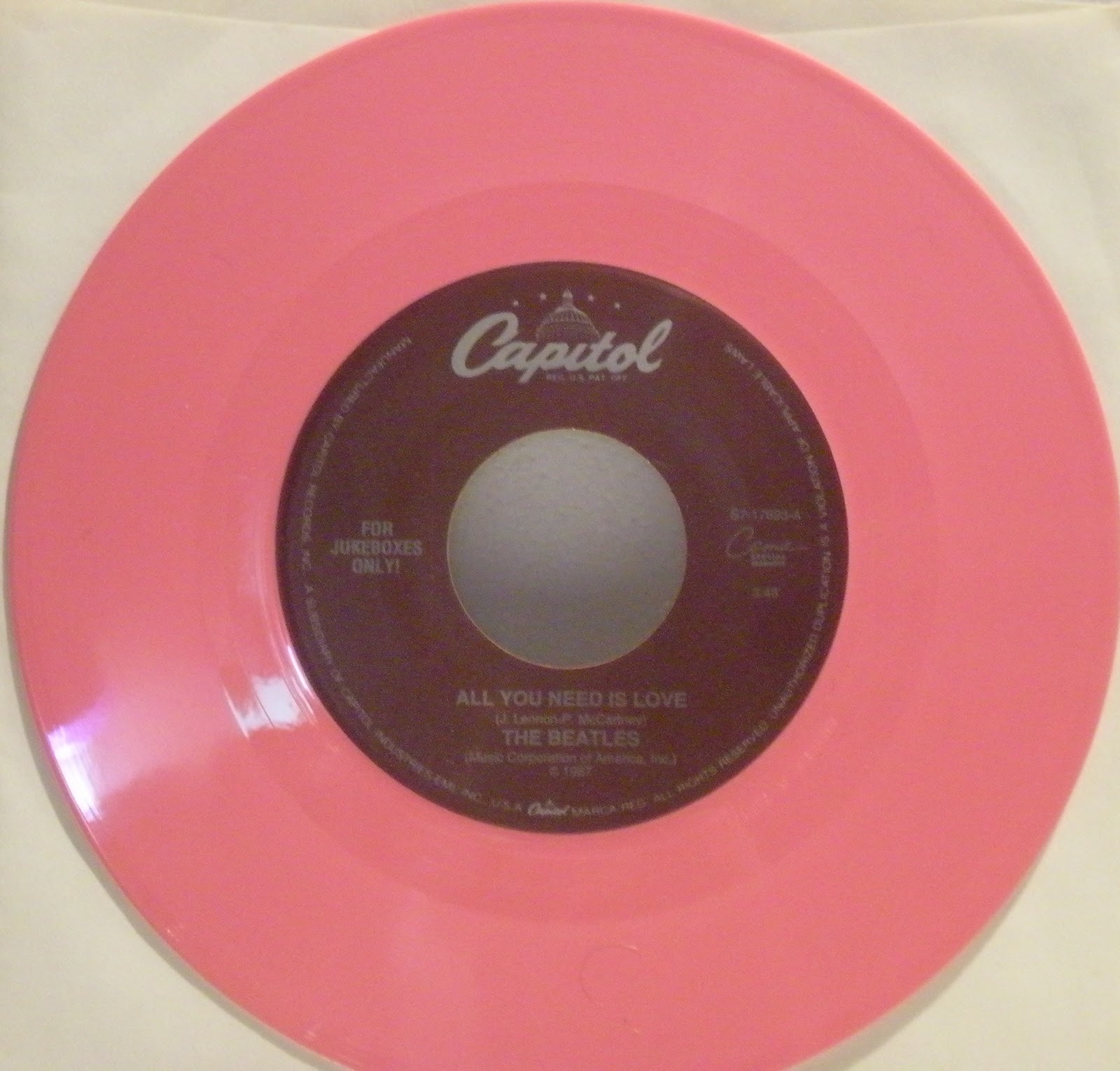 |
| Another Beatles 45 from the same series..... |
 |
| 13th Floor Elevators 1st LP reissue of dubious extraction. This is nicer to look at than to hear. Better to track down the Sundazed mono reissue LP for best sound from this classic! |
 |
| What is it with RED vinyl? This is a Canadian-only issue of "Who Are You". This sounds pretty good, actually! |
 |
| Supposedly, The Pineapples were a great band live. Never saw them though I still may get the chance as they're still making music. The tunes on this 45 are a good example of pre-Nirvana alternative rock - NYC style! This was their only release on Kokopop (a subsidiary of the famous NYC-based label Shimmy Disc). |

 |
| This was a recent score. A colored-vinyl 45 exclusive of Mojo Magazine in celebration of the release of The Beach Boys Smile Sessions. Only found in the magazine - really sweet, actually! |
 |
| I sure like this purple vinyl ELO 45! Sweet Talkin' Woman on side A - Fire on High on side B. Way cool!! |
Wednesday, December 7, 2011
Ahm seein' COLORS!

 |
| This Grand Funk record looks kinda yellow here, but it's almost gold colored in reality. Too bad my copy is kinda trashed, but it still looks nice!! |
 |
| New-ish Meat Puppets release. Great album too. Can't go too far wrong with anything by the Meat Puppets. |
 |
| Rykodisc put out a series of vinyl LPs on clear vinyl. This looked best when I held it to the light. This particular record was the first official Hendrix BBC sessions release (before it reverted to the Experience Hendrix estate). |


 |
| The above three records are original issue Flaming Lips LPs in their color incarnations. Silly me - I should have kept collecting this band on vinyl. Their more recent releases are pretty collectable. I have no idea if these are as collectable - fun to look at though! |
 |
| This was the last new Elvis Presley LP released right at the time of his death. Believe it or not - the really rare issue of this record is, in fact, the BLACK vinyl issue. Blue is common. Still - nice to look at! |

 |
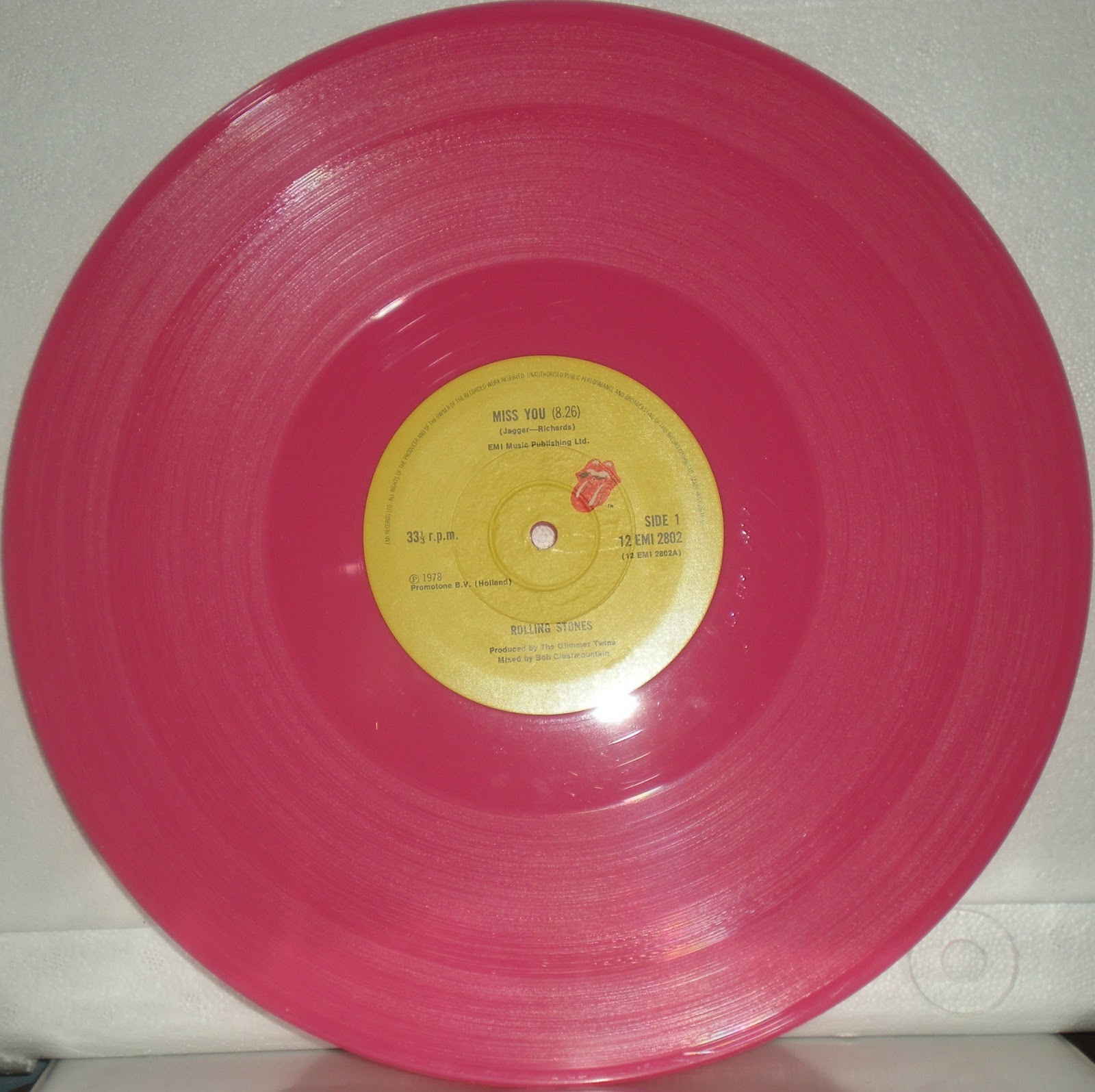
| Some Rolling Stones records. The top two are 12" singles. The one directly above is a Japanese reissue of "Out of Our Heads" - US version. Too bad it sounds awful (mint record - bad mastering!). |


 |
| Some relatively common Beatles color vinyl albums. |
 |
| Rhino reissue of Nazz Nazz. Now, the original CSG Records issue was also put out on red vinyl - that would be a cool score! Maybe someday............ |

 |
| Sundazed reissue of the great (Jan) and (mostly) Dean cult-classic "Save for a Rainy Day". Really beautiful looking records! Interesting music too - I'll have to do an entry on this record sometime soon since it has an interesting history! |
Tuesday, November 15, 2011
Dave Brubeck - Adventures in Time

Funny - this was not a "proper" release from the heyday of the classic Columbia-era quartet, but a compilation album with some live tracks in place of the more popular studio versions of songs. The unifying theme to the record (released in 1972 as a double LP) was to focus on tracks featuring odd time-signatures. "Take Five" was perhaps the most famous example of Brubeck stretching beyond the usual pulse of 4 or 3 (the composition's title referring to the meter of 5/4 the song moves in). But "Take Five" was merely the tip of the iceberg - how about tunes in 7/8, 9/8, 10/4? How can those odd meters possibly even swing? Well, the whole group does indeed swing, but special mention must go to the great drummer Joe Morello. Just even thinking about Joe Morello's superb style of playing makes me smile.
Adventures in Time, being a double record, had a great inside panel of liner notes with the right time signatures listed by each song. In one case, a nifty suggestion was added next to "Blue Rondo a-la Turk" in 9/8 - how to count this? Try one-two/one-two/one-two/one-two-three. It follows the melody perfectly. This blew my mind! Really helped me to understand how to approach unusual time signatures as I imagine it did for a lot of people, actually.
I know most folks reference the studio versions of "Take Five" and "Blue Rondo a-la Turk", but on this album live performances are used (no credits about when or where these took place). For me, these are the definitive versions - the studio cuts sound TAME in comparison. The versions on this record are rollicking and extended with all sorts of great interplay - and much quicker tempos! This collection has never been issued on CD (as far as I know) - maybe the live cuts have been added to CD reissues? I wouldn't know - sorry to admit I don't own much Dave Brubeck on CD. In fact, I really need to add more titles to my shamefully small collection - at some point I will profile another Dave Brubeck Quartet favorite - "Jazz Impressions of Japan".
For now, though - this album is still the tops for me. I even like the quasi-psychedelic cover art. In fact, here's the back cover:

Thursday, November 3, 2011
Move over Smiley, a new SMILE has arrived!

With the newly released Smile Sessions treasure-trove, Beach Boys fans are given another opportunity to re-evaluate the meteoric rise and spectacular crash of California’s greatest myth-makers. If the group’s only contribution was to set the California Dream to music, as their early car and surf hits did so well, the Beach Boys would still be considered a major cultural force of the 1960s. Add to this the great myth-within-the-myth of “The Greatest Unreleased Album of All-Time” and you’ve got a truly special situation on your hands. Smile’s failure to launch in 1967 has given rise to all manner of theory and armchair psychology – predictions about what could have been if only the record was finished and released on time to compete with the Beatles’ “Sgt. Pepper” album. Many hold the opinion that Smile would have wiped the floor with Pepper in terms of artistic achievement, which could very well have been the case.
But I really wonder if it would have made that big of a difference. It is very likely that Smile would have been a critical favorite, yet a commercial flop much in the way Pet Sounds was perceived as such in those days. And it certainly would have been nearly impossible to perform this music live. (Listen to period performances of Good Vibrations – they sound anemic. The Beach Boys didn’t really figure out how to do the song justice in concert until about 1968 when they started augmenting their basic lineup with backing musicians to beef up the sound). What is so alluring about Smile is what it came to represent – the unattainable peak of the frustrated artist cruelly cut down in his prime – stymied by primitive technology, lawsuits and infighting – not to mention the dangerous side-effects of mind-bending chemicals. A tragic fall from grace. Smile’s non-appearance also marked the beginning of the general dispersal of the throngs away from the Beach Boys’ lure. Plenty of great music would follow, but not with the magical qualities that had been the group’s trademark sound under the leadership of Brian Wilson.
Those magical qualities are to be found on the Smile tapes – as odd as the music is in many respects, that “magical quality” is still present. Only in a very few isolated circumstances would that magic reappear on future Beach Boys releases (best heard on the classic track from 1971 “Till I Die”). But it would never return in full force. This is what is most apparent to listeners who hear the original Smile Session tapes. Yes, the music is weird, but not in an unfamiliar way – in fact, the effect is quite brilliant and not unlike the style that Brian Wilson pioneered on the “Good Vibrations” single. Are there any “hit songs” on the record? Well, maybe not (aside from the obvious inclusion of “Good Vibrations”). But the material does have obvious CLASS and artistic merit – something that is not immediately apparent on what was sent out as the replacement in September of 1967.

The old story of how Smile was too weird to lay on the Beach Boys fans – as being a legitimate reason for its non-appearance in June 1967 – can’t be taken very seriously if one gives even a cursory listen to the record that came out in its place. If Pet Sounds was deemed “too weird” by the car and surf set, I cannot begin to imagine the outright indignation Beach Boys fans must have felt when playing Smiley Smile for the first time. How the group ever convinced Capitol Records to release that album is beyond my understanding. And, for the official record – I like Smiley Smile a whole lot. On its own terms it’s an interesting and rewarding album to listen to. But it does stand alone in the Beach Boys catalog as being the Mystery Turkey from Mars.
The overall listening experience of Smiley Smile is so weird – it’s actually a bit unsettling. Fans at the time must have been either convinced that it was a terrible joke or that something seriously wrong happened to these guys. The record was so out of step with the hitherto-accepted Beach Boys image (and sound) it could be argued that it was as rebellious as the Beatles Butcher Cover fiasco in its own way – perhaps WORSE since the release of Smiley Smile derailed the group’s popularity in a way that baby dolls and butcher meat certainly didn’t for the English fabs. The Beatles’ surrealistic psychedelia was, for the most part, whimsical – the Beach Boys psychedelia (as presented on Smiley Smile) was………kinda disturbing, really.
However, I have a theory about Smiley Smile that I’ve never encountered from any of the Beach Boys experts (at least the ones I’ve read). I think it was a gross miscalculation on the part of the Beach Boys in terms of how the record would be perceived by their fans. Consider this pattern: From the album Surfin’ Safari up through Pet Sounds, there were some, for lack of a better expression, “off the cuff” releases the Beach Boys set loose on their fans in those years: Beach Boys Concert, Beach Boys Christmas Album, Beach Boys Party! – these were all quickly thrown-together affairs tossed out onto the market in between the “serious” productions. And consider all the wacky moments found on the “serious” albums : Brian and Mike Love having a scripted mock-fight in the studio, Our Favorite Recording Sessions, Bull Session with the Big Daddy? Remember these little nuggets of weirdness? What were they doing on those records? Are they supposed to be funny? Were they ever? Hmmmmm.
Could it be that the Beach Boys just figured Smiley Smile would be accepted by the fans as a “Beach Boys Pot Party” record? Did they even know just how wacky the record really was? Were they too close to it – in the way the Beatles were too close to the in-jokes in the Magical Mystery Tour movie to notice how incomprehensible it was to the general public? Although the Beatles movie was pretty obscure and impenetrable for most folks to appreciate – at least they were not known for being film-makers. And the music on the MMT album did not sound out of place with the rest of the Beatles catalog up to that point. Smiley Smile was a sore thumb – and there was no logical excuse for this coming from a group known for giving much more care and effort into their work for the most part. To expect the fan base to embrace Smiley Smile – especially as some sort of “sane substitute” to the Smile album! – was, I think, a bit much to ask on the Beach Boys’ part. It cost them dearly.
And if it were only that one record it could have been a different story. Yet – the shift away from that “glorious Brian Wilson sound” was, essentially – a permanent one. Now, of course, there’s no way the Beach Boys would have been selling as many records in 1969 if they put out something that sounded, sonically, like “California Girls Part Two” – the sound of popular music had changed (the shift to stereo being one example). Whether or not Brain Wilson would have been able to lead the group through the stylistic changes of the late 60s and early 70s – in an obvious commercial way – is, I believe, quite debatable. My point is – Smile was not simply abandoned by the Beach Boys on purely artistic issues alone. The path the group took – as a more democratic unit, as opposed to following Brian Wilson’s lead – would never yield either the artistic or the commercial appeal of those golden years between 1962 and 1967.
A major question remains for me : How much were the Smiley Smile, Wild Honey, Friends, 20/20 albums a reflection of democratic decisions on the part of the Beach Boys as a whole or were they still the reflections of Brian Wilson’s artistic choices? All of those records were released with production credits assigned to “The Beach Boys” instead of “Brian Wilson”. Yet, it has been argued that some of the sonic change was attributed to Brian Wilson’s ideas – the out-of-tune piano on Wild Honey, the snarky organ sounds on Smiley Smile. These abrasive kinds of textures would re-appear on later Brian Wilson-led records (The Beach Boys Love You album is the premier example of this).
It seems to me that when Brian Wilson pulled the plug on the Smile sessions it was a conscious decision to lay aside the familiar trademark sound he became known for – that glorious, warm “Phil Spector” approach. If we can argue that Smiley Smile was the result of purposeful artistic choices (instead of simple laziness), what has to be confronted is the proposition that Brian Wilson made a conscious decision to embrace a sort of avant-garde minimalism approach to his music. Was it commercial? Oh, hell no. Interesting? You bet. Just not AT ALL what anyone would have expected from a Beach Boys release – and certainly not as a logical successor to Pet Sounds.
Finally, with the official release of the Beach Boys version of Smile, fans can get a glimpse of what could easily have followed in the wake of Pet Sounds and Good Vibrations, at least from a musical point of view. And maybe after sifting through the many discs of Smile pieces, outtakes, sessions – we, as listeners, might be able to feel ready to move on – just as Brian Wilson did – to consider the merits of all the records from Smiley Smile forward on their own terms. Because, in the end – had Smile actually arrived on schedule in 1967 it is still likely that we would have had Wild Honey, Friends, 20/20 and Sunflower anyway. Maybe without any of the Smile-castoff tracks perhaps, but I would reckon in very similar form nonetheless. It’s just a hunch, but I suspect that Brian Wilson would have liked to conclude his “golden-sound period” with the bang of what Smile promised to be instead of unveiling a new and decidedly less-commercial musical style (in very raw form) as the substitute. I’m glad he’s finally gotten the chance to give listeners the opportunity to hear the results of all that hard work. It’s what we’ve been waiting for all along. Amen.
Subscribe to:
Posts (Atom)